The NASA Lean Test is a simplified version of the tilt table test that was developed for screening astronauts for orthostatic intolerance. It's now recognized as a practical way to screen for POTS and other forms of orthostatic dysfunction at home or in a clinical setting.
Why the NASA Lean Test?
Traditional tilt table tests are considered the gold standard for diagnosing POTS, but they:
- Require specialized equipment and clinical settings
- Can be expensive and have long wait times
- Are not widely available in all areas
- May not be covered by insurance
The NASA Lean Test provides a validated alternative that can be performed at home with consumer-grade heart rate monitoring. While it doesn't replace a formal medical evaluation, it can help identify potential issues worth discussing with your healthcare provider.
The Protocol
The NASA Lean Test follows a specific protocol to ensure consistent, comparable results:
Phase 1: Baseline (5 minutes)
- Lie flat on your back in a comfortable, quiet environment
- Rest completely — don't talk, use your phone, or move unnecessarily
- Your Apple Watch continuously monitors your heart rate
- The app calculates your resting (baseline) heart rate from the final 2 minutes
Phase 2: Stand Transition (~20 seconds)
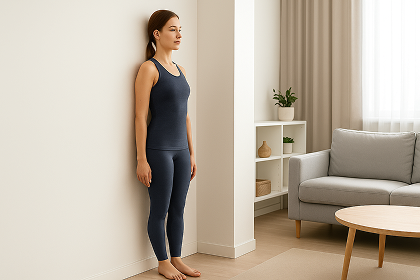
- When prompted, stand up smoothly and lean against a wall
- Your heels should be about 6 inches from the wall
- Only your shoulder blades and buttocks touch the wall
- The app uses your iPhone's motion sensors to validate your posture
- You need 5 seconds of stable posture to begin the standing phase
Phase 3: Standing (10 minutes)
- Remain standing against the wall for 10 minutes
- Stay as still as possible — don't shift weight, talk, or use your phone
- Your heart rate is continuously monitored
- You can log symptoms using the button on your Apple Watch
- Optionally enter blood pressure readings at prompted intervals
Phase 4: Recovery (1 minute, optional)
- After standing, you can sit or lie down
- The app measures how quickly your heart rate returns to baseline
- This can provide additional insight into your autonomic function
Why Leaning Against a Wall?
The "lean" position is key to the test's effectiveness:
- Minimizes muscle movement: Standing freely requires constant small muscle adjustments that can affect heart rate
- Standardizes posture: The wall provides a consistent reference position
- Maximizes blood pooling: The relaxed posture allows gravity to have its full effect, revealing abnormal responses
- Safety: The wall provides support if you feel faint
What Makes It "NASA"?
NASA developed this test to screen astronauts returning from space missions. After spending time in microgravity, astronauts often develop orthostatic intolerance — their bodies have adapted to not fighting gravity and need to readjust.
The NASA Lean Test proved effective at identifying these issues in a practical way that didn't require expensive tilt table equipment. Researchers later found it equally useful for screening the general population for POTS and other orthostatic disorders.
Test Preparation Tips
For the most accurate results:
- Avoid caffeine for at least 2 hours before testing
- Avoid alcohol for at least 12 hours before testing
- Avoid large meals for 2 hours before testing
- Stay hydrated but don't overhydrate right before
- Test at the same time each day for comparable results
- Wear comfortable clothing that doesn't restrict circulation
- Use the bathroom before starting
- Find a quiet space where you won't be interrupted
Safety Considerations
Important Safety Information
Stop the test immediately and sit or lie down if you experience:
- Severe dizziness or feeling like you might faint
- Chest pain or pressure
- Difficulty breathing
- Vision changes (graying out, tunnel vision)
- Extreme weakness
If symptoms persist after lying down, seek medical attention.
Limitations of Home Testing
While the NASA Lean Test is valuable for screening, it's important to understand its limitations:
- Consumer sensors: Apple Watch uses optical heart rate monitoring, which is less precise than medical-grade ECG
- No blood pressure monitoring: Apple Watch cannot measure blood pressure (manual entry is optional)
- Self-administration: Clinical tests are supervised by trained professionals
- Environmental factors: Temperature, stress, and other factors can affect results
This is why POTS Check is designed as a screening tool to help you gather data for your healthcare provider, not as a diagnostic device.
Ready to Try It?
POTS Check guides you through the entire NASA Lean Test with real-time feedback, posture validation, and automatic heart rate analysis.